I Didnt Know You Were Funny
10 Extremely Precise Words for Emotions You lot Didn't Even Know You lot Had
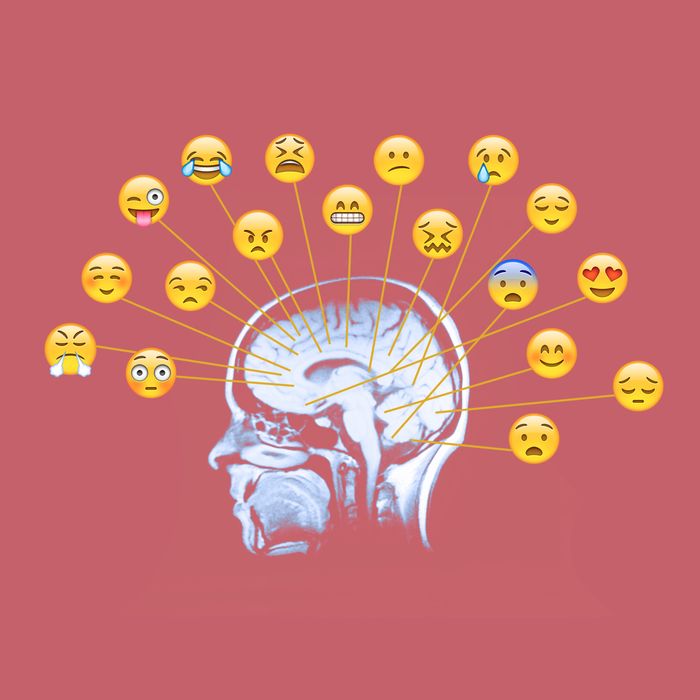
In recent years, neuroscience has introduced a new way of thinking nearly our emotions. The scientists behind the latest encephalon-imaging studies say they can now pinpoint with precision where these feelings are located inside our heads. In 2013, for instance, a squad of psychologists published a study in which they claimed that they had found neural correlates for nine very singled-out man emotions: acrimony, cloy, green-eyed, fear, happiness, lust, pride, sadness, and shame.
This is an intriguing trend for academics like Tiffany Watt Smith, a research beau at the Eye for the History of the Emotions at Queen Mary University of London. "It'southward this idea that what we mean by 'emotion' has evolved," Smith tells Scientific discipline of U.s.a.. "It's now a physical thing — you can see a location of it in the brain." And yet, of class, that's non all an emotion is; calling the amygdala the "fear center" of the brain offers piddling help in understanding what it ways to be afraid.
Information technology's exactly that — the subjective experience of emotions — that Smith explores in her mannerly new book, The Book of Human Emotions. It's a roundup of 154 words from effectually the earth that you could phone call an exploration of "emotional granularity," every bit it provides language for some very specific emotions yous likely never knew you had. "It'due south a long-held thought that if you lot put a name to a feeling, it can help that feeling get less overwhelming," she said. "All sorts of stuff that's swirling effectually and feeling painful can start to feel a fleck more manageable," one time yous've pinned the feeling downwardly and named it.
The odd thing about writing a book about detached emotions you never knew existed is that y'all outset to experience them — or is it that you were already experiencing them, and it's simply that now you know the proper noun? Either way, Smith tells Science of Us that, while writing her book, she plant herself batting abroad offers of help from others considering she didn't want to put them out. That is, she was feeling greng jai, a Thai term (that'southward sometimes spelled kreng jai in translation) for "the feeling of being reluctant to accept another's offer of assistance because of the bother it would cause them."
Below you lot can find a brief list of ten more extremely precise words for emotions. But off-white alert: Once you lot are introduced to the feeling, you may find yourself feeling it more than often.
Amae: To be an adult, particularly in a nation like the U.s.a., is to be self-sufficient. Yet there is something very overnice, in an indulgent kind of mode, almost letting someone else handle things for you every once in a while. The Japanese discussion amae, every bit Smith defines information technology, means "leaning on another person'south goodwill," a feeling of deep trust that allows a relationship — with your partner, with your parent, even with yourself — to flourish. Or, as the Japanese psychoanalyst Takeo Doi has put it, it'due south "an emotion that takes the other person's love for granted." It's a childish kind of love, in other words, equally evidenced past an alternate translation of the word: "behaving like a spoiled child."
L'appel du vide: You're waiting for the railroad train when an inexplicable idea flashes into your mind: What if you jumped off the platform? Or maybe you're driving up some precarious mount pass, when you lot experience strangely moved to jerk your steering cycle to the right and sail clear off the route. American psychologists in 2012 published a paper in which this feeling was dubbed the "high place phenomenon" (and their study suggested, by the way, that its presence does not necessarily signal suicidal ideation), but the French term for the phenomenon is much more alluring, every bit French words so often are: l'appel du vide, or "the telephone call of the void." As the philosopher Jean-Paul Sartre once observed, the emotion is so unsettling because of the way it "creates an unnerving, shaky awareness of not being able to trust i'south ain instincts." It's a reminder, then, to perhaps non always let your emotions rule your behavior.
Awumbuk: It'south a funny matter about house guests. While they're in your dwelling and you're tripping over the extra shoes and suitcases that are suddenly littered virtually your living room, you beginning dreaming virtually how overnice it volition exist when they get out. Yet, after they practice, your place oftentimes feels too empty. To the Baining people of Papua New Guinea, Smith writes, this feeling is and so prevalent that it gets a name all to itself: awumbuk, or the feeling of "emptiness after visitors depart." In that location is, luckily, a fashion of ridding the domicile of this rather melancholy feeling: Smith writes that "once their guests have left, the Baining fill a bowl with h2o and leave it overnight to absorb the festering air. The next day, the family rises very early and ceremonially flings the h2o into the trees, whereupon ordinary life resumes." That's one way to practice it.
Brabant: In 1984, writer Douglas Adams and Television receiver one-act producer John Lloyd paired up to publish a book chosen The Deeper Pregnant of Liff: A Dictionary of Things At that place Aren't Any Words for Yet–Just There Ought to Be. Smith apparently agreed with these 2 on at least this: that there should be a word for the fun of pushing someone's buttons, to see how much you lot tin tease them until they snap. Adams and Lloyd defined the discussion as the feeling you get when you are "very much inclined to encounter how far you can push someone." (To my listen, an alternating definition might exist "having a younger brother or younger sis.")
Depaysement: People do some out-of-character things in strange countries. They strike upwardly conversations with strangers in bars, even if they would never do the same back home. They wear unflattering hats. There's something about being a stranger in a foreign land that's equal parts exhilarating and disorienting, and this messy mix of feelings is what the French give-and-take depaysement — literally, decountrification, or existence without a country — means to capture. It's "the feeling of being an outsider," and though getting lost because you can't quite read the street signs also every bit you maybe thought y'all could tin be unsettling, the feeling of being somewhere else just equally often "swirls united states upwards into a kind of giddiness, just ever felt when far away from domicile."
Ilinx: There exists a GIF of a fluffy white true cat that speaks direct to my soul. In it, the cat is perched atop a desk-bound, and as its human places various objects near its paws — a lighter, a glasses case, a wallet — it pushes each item off the desk and onto the floor. Y'all might say the animal is expressing ilinx, a French word for "the 'foreign excitement' of wanton destruction," as Smith describes it, borrowing her phrasing from sociologist Roger Caillois. "Callois traced ilinx back to the practices of ancient mystics who past whirling and dancing hoped to induce rapturous trance states and glimpse alternative realities," Smith writes. "Today, even succumbing to the urge to create a minor chaos by kick over the office recycling bin should give y'all a balmy hit."
Kaukokaipuu: People of, say, Irish descent who have never actually been to the land of their beginnings may notwithstanding experience an unexpected ache for it, every bit if they miss it — a strange, contradictory sort of feeling, every bit you can't actually miss someplace you've never been. But the Finnish recognize that the emotion exists, and they gave it a name: kaukokaipuu, a feeling of homesickness for a place you've never visited. It tin can too hateful a kind of highly specified version of wanderlust, a "craving for a distant land" — dreaming from your desk about some far-off place like New Zealand, or the Hawaiian Islands, or Machu Picchu, with an intensity that feels almost similar homesickness.
Malu: Y'all'd like to call back y'all are a person of boilerplate conversational and social skills, and nevertheless this all evaporates the moment you find yourself sharing an elevator with the CEO of your company. The Dusun Baguk people of Indonesia know how yous feel. Specifically, Smith writes that they would call this feeling malu, "the sudden experience of feeling constricted, inferior and bad-mannered effectually people of college status." Instead of this being something to be embarrassed about, however, Smith's research has shown that in this item culture it'southward considered an entirely appropriate response; it's even a sign of skillful manners. Something to remember the next time your mind goes blank when your boss asks you a question: You are only being polite.
Pronoia: At one bespeak in J.D. Salinger's Raise High the Roof Beam, Carpenters, Seymour Glass muses nearly himself, "Oh, God, if I'm anything past a clinical proper name, I'g a kind of paranoiac in reverse. I suspect people of plotting to make me happy." About three decades after, sociologist Fred Goldner came upwardly with a proper name for this: pronoia, the opposite of paranoia. Instead of the fear that you lot are at the heart of some diabolical lot, pronoia, as Smith describes it, is the "foreign, creeping feeling that everyone's out to help y'all." And, hey, just considering you lot're pronoid doesn't mean they're not out to help y'all.
Torschlusspanik: Life is passing you lot by. The borderline'due south approaching. The train's a-comin'. Literally translated from German, torschlusspanik ways "gate-closing panic," a word to summarize that fretful sensation of time running out. Information technology may serve yous well, when experiencing this panicky emotion, to hesitate earlier assuasive information technology to spur yous toward impulsivity, and call to heed the German idiom Torschlusspanik ist ein schlechter Ratgeber — that is, "Torschlusspanik is a bad adviser."
Source: https://www.thecut.com/2016/06/10-extremely-precise-words-for-emotions-you-didnt-even-know-you-had.html
0 Response to "I Didnt Know You Were Funny"
Enregistrer un commentaire